
Exploring the spiritual journey of three visionary artists: Wassily Kandinsky, Hilma af Klint, and James Mahu
Korean writer Han Kang, author of The Vegetarian and other books and poetry, won the 2024 Nobel Prize for Literature. In her speech at the ceremony, she read the first stanza of one of her poems:
Where is love?
It is in my thump-thumping beating heart.
What is love?
It is the gold thread connecting between our hearts
She wrote this when she was 8 years old, and she somehow knew then that the heart was the source of love, and that understanding love would be fundamental to her explorations in all her writing. She reflected on this poem written 46 years prior and sensed the continuity of her 8-year-old self and who she had become as an adult; a transmitter of “this golden thread that joins–a thread that emanates light.” Her writing has become the language and transmission of her heart, emanating out into the world through this golden thread, eclipsing all boundaries to touch the hearts of a wide and diverse audience all over the world.
This exemplifies the mystery and the mystical power the heart has represented for thousands of years.
The heart is somewhat of an enigma. In ancient times, it was considered the seat of the soul, the gateway to the spirit realm for guidance and wisdom by tribal leaders and healers. In the last few hundred years, science repositioned the heart as a mechanical pump and nothing more, thus, the heart’s ancient powers were relegated to the margins of mythology and cliche. In more modern times, the heart has been associated with our emotional system but viewed as an instrument of the mind brain. Today, a new understanding is emerging that suggests the opposite, that the mind brain is the instrument of the heart.
The Heartmath Institute in Boulder, California, has spent the last 34 years studying the heart, not just a physical organ, but on the heart’s role in emotions, cognition, and overall wellbeing, particularly with the heart brain interactions and coherence. Through scientific inquiry, they have shown that the heart has a complex neural network often called the “heart brain,” which can process information, learn, and make decisions independently of the cranial brain. They have found that the heart, when in a state of Heart Coherence (a smooth, rhythmic pattern in the heart rate variability), enhances intuitive intelligence, inner peace, and stress reduction, and enhances access to creative insights.
Two of HeartMath’s practices, such as heart-focused meditation and the Quick Coherence Technique, can foster deeper states of presence and a sense of unity. Their studies have shown that the heart can access intuitive knowledge before the brain registers it, suggesting a deeper, nonlocal intelligence and connection to our collective consciousness.
I think there is a compelling conceptual connection between HeartMath’s research on this collective consciousness and scientific quantum theories such as quantum vacuum, quantum entanglement, and string theory. All of these scientific concepts suggest an interconnected field that permeates all of existence.
While science does not confirm that human consciousness directly influences the quantum field, it does provide a scientific foundation for understanding interconnectedness, which aligns with many ancient and spiritual traditions.
In the ancient spiritual traditions and what HeartMath is advocating, connecting to this unified field of consciousness has profound benefits, and it is what every artist seeks as a source of creativity, and the heart is the center of this connection.
It would be fair to say we have all used or heard references to the heart like; your heart knows best, listen to your heart, let your heart guide you, she has a heart of gold, or he has no heart, and on and on. These are generally referring to a general understanding that has been passed down for thousands of years through almost all religions, cultures, tribes, and mystical teachings. The idea is that the heart represents a more loving, kinder, moral, virtuous, and emotionally intelligent way of responding to life. These sayings have become truisms that get thrown around unconsciously, but the true understanding of the heart and its unique ability remains obscured on the outer fringes of what is scientifically accepted.
This concept is changing thanks to HeartMath and others who recognize the heart’s significance in our quest to expand what is possible. The energetic heart then is the portal by which we can access intuition, surpass boundaries of our five senses, and communicate with this larger field of potentiality and intelligence.
Intuition and imagination are cornerstones of the artist’s expression of creativity. Many artists are naturally aligned with the heart because of its ability to bypass boundaries and differences and speak in a universal language of empathy, compassion, understanding, and interconnectedness. The heart is unbiased, inclusive, and boundless in its expression as a noble guide. This opens a space where the artist can hold up a mirror to culture, be provocative, challenge the herd mentality, and explore new and expansive ideas. Art is the ultimate universal expression for exploring our deepest inner questions and ideas. Art is the vocabulary we need to go beyond what is known and understood, and it is free from societal validations and approvals. As artists guided by the heart in conjunction with the logic of the mind brain, we can use art as the vocabulary to push the boundaries of a limited entrenched system.
There are activational artists that see their responsibility to use the vocabulary of art to stand in opposition to the programmed social order and offer new uncharted horizons to consider. In contrast, representational artists create art based on physicality, which can be beautifully powerful also, but my focus here is on the activational artists.
One of the most common references to the heart that we can all relate to is “follow your heart,” and most would agree this is good advice, but who knows how to do this? Very few.
How do we learn to follow the heart that enhances our intuition, insight, creativity, and imaginative abilities? There are many ways to foster this state, they require a deeper dive into heart qualities. Heartmath offers workshops, books, scientific papers, techniques, training, and technology to help in this regard, and I strongly recommend them.
At the Presenting Institute, Otto Scharmer’s Theory U process emphasizes the need to “open the heart” to shift from ego driven awareness to a deeper, more interconnected perception. By opening the heart, Scharmer argues that individuals and organizations can tap into a deeper source of wisdom, enabling transformation and innovation that aligns with the highest potential of the system.
The purpose of Theory U is to guide individuals and organizations through a deep transformational process by shifting from habitual, ego driven reactions to a more conscious, heart centered, and co-creative approach, enabling them to sense and actualize their highest future potential.
In alignment with HeartMath and Theory U is another practice that I adopted about 17 years ago; it is the practice of the six heart virtues of appreciation, compassion, forgiveness, understanding, and valor. This is a practice where I process all incoming and outgoing interactions in my local reality through the prism of these virtues. It is a means by which we can manage our emotions, reduce fear, anxiety, stress, and develop clarity for meeting any situation in life with wisdom, confidence, and creativity. This process also emphasizes the importance of a still mind, to listen to the heart, free of the ego mind’s compulsive stream of thoughts, that if left unacknowledged, runs our life.
Through this practice, I can tune myself to a higher frequency of awareness, much like tuning a radio to receive a clear specific signal. In this case, I dial into heart and sense the virtues that inform my actions and behaviors to align with my highest purpose. This article is not about these specific practices, but for more about this practice, see “Resources” at the end of this article.
If the heart is a portal to increasing intuition, creativity, imagination, and breaking down boundaries and differences that divide us, it is essential for the artist to set our heart as the origin point from which all creativity flows.
Throughout history, artists have naturally connected to their hearts knowingly or unknowingly to express their passion and message through painting, sculpture, music, poetry, dance, and theater.
Wassily Kandinsky
One such artist was Wassily Kandinsky (1866–1944), who was a Russian painter and art theorist, widely regarded as one of the pioneers of abstract art. He studied law and economics, but this left him unfulfilled, and he began contemplating the deeper questions about the meaning of life, who he was, and why he was here. In his thirties, he shifted his focus and found a new path to explore these questions in art and music.
He devoted his life to painting, and after a few years of exploring realism, impressionism and symbolism, he gravitated toward abstraction, believing that art should evoke emotions in the same way as music. His major works, such as Yellow, Red, Blue (1925), showcased his use of bold colors, dynamic shapes, and rhythmic compositions. He felt that abstract painting was much like music and could be expressed as such and experienced as such for the viewer.
His theoretical writings, particularly his seminal book Concerning the Spiritual in Art (1911), laid the foundation for abstract art by insisting that visual elements could express deep, universal emotions without representing physical reality. He believed that artists had a profound responsibility to awaken the soul and reach higher spiritual awareness.
Just as a composer arranges notes into a symphony, Kandinsky arranged line, color, and shapes into a visual composition to evoke emotion and spiritual insight without representing physical reality. Just as instrumental music does not need a narrative to explain the music; Kandinsky’s art did not need words or physical objects to support or communicate his message or idea. The viewer has only to quiet the logical mind and allow inner space to feel the movement, color, and forms. Kandinsky knew that many would not understand his art, but he was convinced that those who were willing to view without the logical mind would feel the power of abstract art to transport the observer to higher spiritual levels.
Kandinsky’s spiritual vision influenced not only abstract art but also later movements like Abstract Expressionism and color field painting. Artists like Mark Rothko and Jackson Pollock continued his ideas about the emotional and transcendent power that color and form can have on the viewer.
His blend of art, music, and spirituality continue to be foundational in modern art theory, inspiring other artists who see painting as a medium for inner transformation and interconnectedness.
Yellow, Red, Blue (Figure 1) was painted in 1924, which is a good example of how his paintings can evoke a sense of music; in this case, it embodies the feeling of the vibrant sounds of a jazz club. It could be viewed or heard as music, but it told a story of a spiritual journey that Kandinsky was conveying.
Kandinsky was fascinated by the meaning of color, where yellow conveyed heat, excitement, or even madness or rage, and it is an earthly color that did not represent profound spiritual meaning. Thus, we could say the yellow on the left side represents the realm of human ego personality, searching, confused, fearful, and in pain. A symphony of many shades, intersecting with lines and connecting forms to represent the complexity of the dualistic world somewhat void of spirit. The story starts here on the left side. It represents the baselevel animalistic human consciousness, perhaps even soulless.
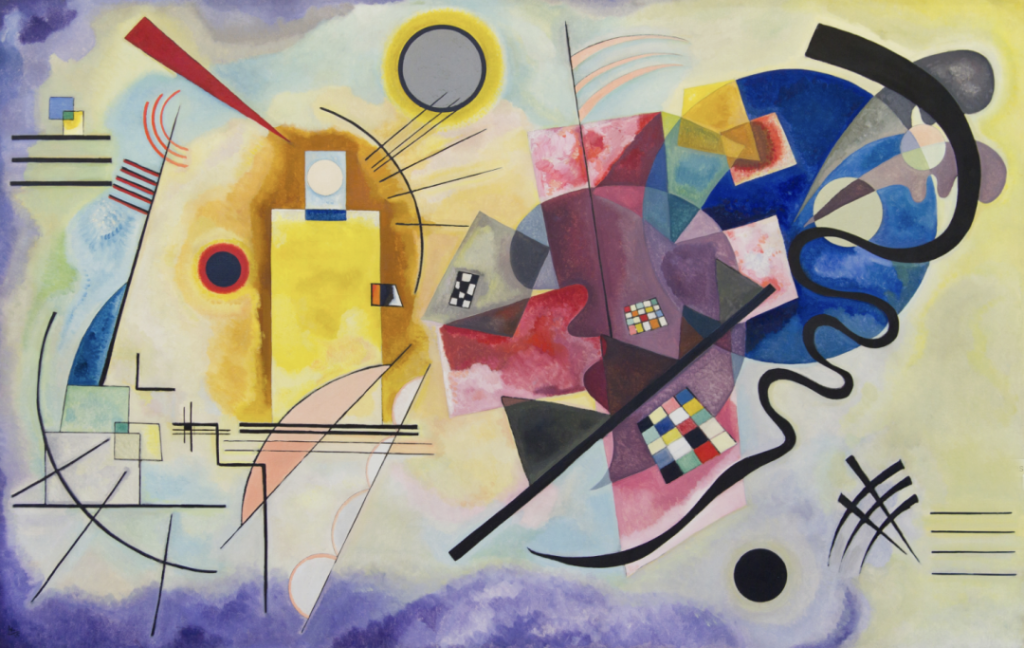
We are led by lines and form to the right into reds that can also be both like a flame, warm and exciting, or painful. The red represents the flame of inner desire of the heart’s search for truth, meaning, and purpose. The red is intermixed with varying shades, lines, and shapes, some dark, representing obstacles, struggle, and the challenges to finding peace through the relentless pull to comply with social conformity.
The story, culminating on the right, is represented in blues, signifying cool, deep spiritual explorations potentially representing inner dimensions or supernatural spiritual insights. This was the destination of the journey, depicted here as a large blue circle representing spiritual harmony and infinity. But this too is obscured with lines, shapes and color representing the ongoing difficulties of the spiritual seeker.
This is a painting about the search for meaning, spiritual insight, and the struggle to attain higher realms of consciousness. Kandinsky’s spiritual journey.
Kandinsky’s paintings were to be experienced not only visually, but hearing them, feeling them, sensing them like Beethoven’s ninth symphony, it is about his deeply emotional spiritual quest from adversity to self-reflection and longing to the final movement “Ode to Joy” representing the ecstatic transcendent potential and highest aspirations that humans long for.
For Kandinsky to trust his feelings and urges, he had to follow and trust his heart, to listen to the intuitive impulses and allow his hand to be moved by these impulses free of the logical mind. Like so many artists, to create abstract art requires letting go of the mind and allowing inner creative insight to flow through their hands.
Hilma af Klint
Another artist who was an outlier and a trailblazer was Hilma af Klint (1862–1944), a Swedish painter and mystic whose work is now recognized as one of the earliest examples of abstract art—predating Kandinsky. She was deeply influenced by spiritualism and mystical traditions. Af Klint believed her paintings were guided by higher spiritual forces and intended to communicate profound metaphysical truths. She and a group of women called The Five conducted séances, where they claimed to receive instructions from spirit guides for their artistic work.
Af Klint was deeply influenced by spiritualism, modern science, and nature, and her paintings all reflected these interests. One well known person in the same spiritual circles whom she looked up to was the Austrian, occultist, clairvoyant, and philosopher, among others, Rudolf Steiner. On af Klint’s invitation in 1908, Steiner visited Klint’s studio to view her latest body of work called “Paintings for the Temple series, 111.” To her disappointment, Steiner was not impressed and stated that her work with a specific medium was perhaps misguided. She was left devastated and stopped painting for a period of time. However, Steiner did tell her that it would take 50 years for people to understand and decipher her paintings.
Eventually, she began to paint again but was convinced by Steiner that the current art world would not understand or appreciate her art for many years to come. In her will, she left all her art to her nephew and stipulated that her work remain hidden for 20 years after her death.
Klint’s art remained mostly unseen for decades after her death until a landmark exhibition at the Solomon R. Guggenheim Museum in New York (2018–2019) showcased her paintings and highlighted her long-overlooked contributions to abstract art. It was a groundbreaking moment in modern art history. It was the first major U.S. retrospective of af Klint’s work and became the most visited show in the museum’s history. This was a major testament to the public’s interest in the origins of abstract art and her spiritual/mystical influences that challenged the status quo of the entrenched tribalism mindset in the art world at that time.
Her artwork titled “What a Human Being Is” (Figure 2) is a good example of the Symbolism art movement and is representative of af Klint’s expression of abstract spiritual concepts.
All abstract art is subjective and can be interpreted differently by each viewer. Once again, if we view abstract art with an open heart, leading with emotional and intuitive sensing and the brain only providing practical knowledge, we can sense more of what the artist’s intentions were.
To me, this painting represents the human journey from the lower states of consciousness and duality, shown as mirrored dark grays and black opposing sections at the bottom of the painting. Rising up in the center of the painting is a spiral representing human evolution or transformation. It works its way up into the circle, which represents wholeness, or all, yet still divided in half.
The two mirror images of the prism rainbow of colors emerge from a central point of entry into the circle of life. These two-color rainbows express the dualistic reality and infinite diversity of our reality. It has a flat surface, possibly suggesting the surface world of form still in the lower realms of consciousness.
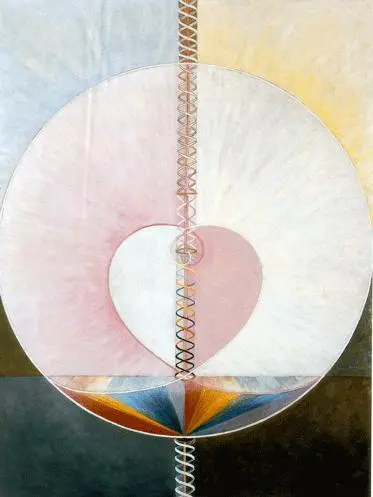
The spiral continues through the world of duality and enters a large heart, signifying its importance in attaining higher states of consciousness. The spiral continues up beyond the world of form into the outer higher unknown spiritual realms.
The painting depicts a journey of consciousness through the human heart into the higher spiritual realms of consciousness, understanding, purpose, and connection to the source.
Klint’s works, with their fluid forms, vibrant colors, and geometrical shapes, can be viewed as reflections of inner emotional or spiritual states, which are often associated with the heart in many mystical teachings.
James Mahu
Moving on to a living artist, although one of the most interesting and prolific artists who remains mostly unknown in the art world, James Mahu is an artist, philosopher, poet, musician, author of six novels, and the creator of the Wingmakers mythology. He has had a profound influence within the spiritual and metaphysical communities.
Mahu has written extensively on the heart as the portal to higher states of consciousness, ultimately to achieve a state called the Sovereign Integral, a state of self-awareness that blends the finite human consciousness and the infinite collective consciousness.
Each painting, as well as all his collective work art, writing, music, poetry, novels, and philosophy papers are each like signposts designed to introduce–at the very least, contemplation–of this higher state of consciousness that he feels is essential for the next phase of human evolution.
Mahu describes his art this way: “My work is generally abstract surrealism meets magical realism.” He has been influenced by “sharing stylistic similarities to Georgia O’Keeffe and Hilma af Klint.” James also says his art is influenced by three disciplines: quantum physics, consciousness, and mysticism. Mahu takes the spiritual ideas that Kandinsky and af Klint were trying to express much further as a spiritual master. His art is the activator for the observer to shift from passive viewer to a receptive listener of abstract spiritual concepts.
I will only focus on one of his paintings and attempt to give you an idea of how James Mahu uses the language of art to share his specific spiritual concepts.
In his painting called “Chamber Thirteen” (Figure 3), Mahu depicts the wholeness of consciousness, or as science would say, the quantum vacuum. Mahu refers to it as The One, Many and All consciousness. The swirling, flowing overlapping shapes represent the infinite dimensions within the vast source consciousness. These dimensions are constantly in motion, always shifting, expanding infinitely. Everything is interconnected, nothing is alone or disconnected in this sea of ever expanding activity.
The shifting green lines and shapes at the bottom depict the lower dimensional levels of duality. They are all intertwined as they rise up to higher levels of consciousness indicated in shades of blues.
James Mahu integrates sacred geometry, ancient symbols as part of the mythological story he weaves. One symbol or glyph that is repeated throughout this painting is the “spiral,” which represents the symbol of the doorway or portal between duality and the higher spiritual realms. The spirals give the impression of motion, suggesting the portals are constantly shifting, appearing, and disappearing in the fabric of the quantum field. They represent opportunities to access the divine or higher states of consciousness, or the Sovereign Integral state, the highest state of consciousness a human can achieve.
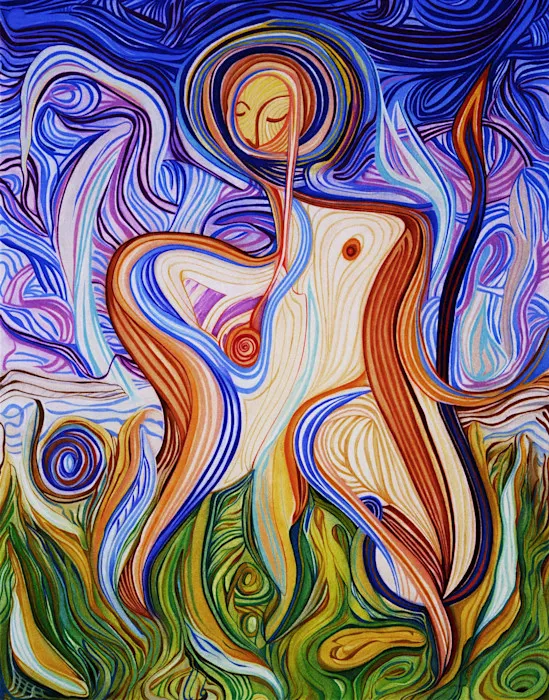
We see what looks like a feminine face peering through one of the spirals (portals). This face represents First Source. She is the creator and observer of all creation, the one who gave birth to the universe and all life. Her face shows us that it is through the spiral that we can access her. She is omnipresent, connected to everything and everywhere. Just below the face is what appears to be a breast, signifying she is the giver and sustainer of all life.
These spirals (portals) seem fluid, constantly appearing and disappearing, and this is so for each and every person throughout their lives. Each of us is an integral part of the all and has free will to choose to enter a portal at any time, but we linger in the lower dimensions of duality.
Another symbol Mahu uses in many of his paintings is the snake-like pictograph; here, we see two. In biblical terms, the snake is the tempter of the tree of knowledge, which is the world of good and evil, duality, or polarity. In Mahu’s painting, this symbol signifies that polarity or duality always exists and ultimately leads to fear, judgment, and blame.
The painting depicts the interconnectedness of all things, all life, and all dimensions known and unknown. Each of us is inside and an integral part of this complex field of potentiality. It is an invitation to use your imagination and enter a portal into higher levels of consciousness and transformation. Mahu depicts our creator as patient, watching and loving and always present and omniscient.
The painting is hopeful and encourages us to discover new horizons, enabling unlimited possibilities. If we look at the painting through the eyes of the heart, feeling the lines, shapes, and colors, we allow the painting to evoke emotion, trigger insight and inspiration, understanding and creative insight.
Mahu uses his art as a means to communicate abstract spiritual concepts where words falter. Through color, shapes, line, sound, and movement, these concepts can be transmitted to open and receptive hearts.
Underlying all Mahus’ art is to encourage the observer to consider igniting the heart’s powerful abilities to enhance their lives, particularly by practicing the six heart virtues.
These three activational artists have something in common: they create art that is abstract, expansive, and not pinned down to a single answer or meaning. They felt that their art is coming through them from inside, from a higher dimensional realm, with a message that is mysterious, mystical, abstract, and expansive yet not of words. They used color, shapes, and lines to articulate the idea that there is more to our small, limited physical lives, and art was the language to explore this mystery.
Each painting shifts and changes based on the unique perspective of each observer. The intent or the purpose of the art is to invite or activate the observer, it is like a doorway into the world of the artist’s imagination.
The observer–you and I–choose to walk through the doorway or stay in the safety of the familiar. This is the beauty of art: painting, sculpture, writing, music, and dance invites us to expand our boundaries of what is possible as a human, and this is the spiritual quest the artist pursues.
We are all artists, creator beings, who use our choices, beliefs, and actions to create the world we experience. Our beliefs, behaviours, and the activities we spend our time on in every moment are the brushes that we apply to the great canvas of life. We are either living life as passive observers or we are living as artists painting on the canvas of life with every thought, belief, and movement of our body.
Take a chance, decide to be an artist guided by your heart, and let your life be your living art for the world to see, enjoy, and appreciate.