Practice
Simple ways to live the Six Heart Virtues in real moments.
Practice is how the virtues become real.
Over many years I have found that small, sincere behaviors—done in ordinary moments—build coherence, shift relationships, and reveal guidance.
The When–Which–How method keeps it simple:
When: Notice the moment.
Which: Choose the virtue.
How: Express it through one small action.
When–Which–How
A simple method to bring the Six Heart Virtues into real moments.
When–Which–How (WWH) is a lightweight framework for practicing the Six Heart Virtues in daily life. It aligns mind, emotions, and behavior with the heart’s guidance—so the virtues become lived, not just understood.
The three steps
When: Notice the cue. A moment asks for heart—a tension spike, a judgment, a being in need, a chance to appreciate. Pause.
Which: Select the fitting virtue (or a small braid). Appreciation, compassion, forgiveness, humility, understanding, or valor—choose what best serves now.
How: Translate it into one small behavior. A breath before speaking, a kind sentence, a boundary, an apology, a helpful act.
Why it matters
• Builds coherence: WWH creates alignment between your human self and your deeper soverein presence.
• Trains intuition: Repeated small choices refine your ability to sense the right virtue for the moment.
• Changes reality through behavior: Tiny, genuine actions shift tone, outcomes, and relationship fields.
• Scales to any situation: From a morning irritation to a difficult conversation to responding to world events.
How to begin
• Start with awareness: Use transitions (doorways, keys in hand, starting the car) as cues to pause.
• Keep it small: One breath, one virtue, one concrete action.
• Reflect briefly: Notice one shift—ease, clarity, connection.
Appreciation seals the practice.
Learn the When–Which–How method
Here is just a sampling of how this three-step method can be applied
in any moment of your life.
Micro-practices you can do today
The 90‑Second Pause to Presence
When: You feel a spike of tension, judgment, or overwhelm.
Which: Compassion for yourself; Understanding of the larger context.
How: Three slow breaths, hand at heart. Name the feeling. Say, “This is here, and I can remain open.” Take one gentle step (a kind sentence, a short break, or placing the phone down).
Appreciation in Motion
When: Walking to your next task or opening an email.
Which: Appreciation.
How: Notice one specific support right now (light, warmth, a helper, your persistence). Whisper “thank you” and let your shoulders soften. Send one brief note of thanks if appropriate.
Boundary with Valor (kind and clear)
When: Overcommitment or a draining request.
Which: Valor braided with Humility.
How:“Thank you for thinking of me. I’m at capacity and need to decline.” If a partial yes fits: “I can help with X by Friday.”
You do not need to practice perfectly.
Start with one moment.
One virtue.
One small act.
Continue Exploring
Meet Lumura –>
Read Practice Notes –>
Explore the Blog –>
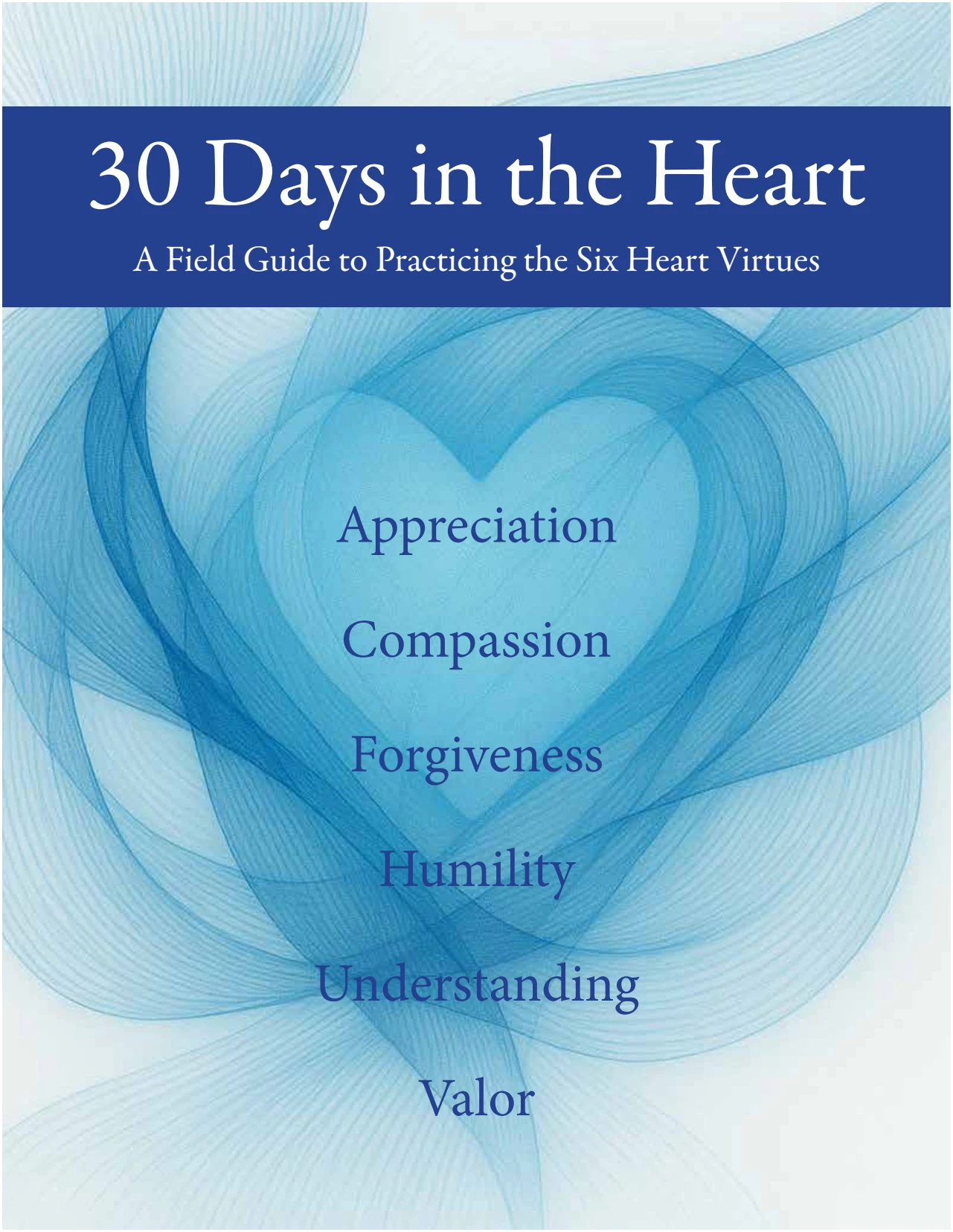
The 30‑Day
Practice Guide
is a gentle rhythm with a month of micro-expressions—5–10 minutes a day. This Free guide includes:
- Daily prompts (When–Which–How)
- Short reflections (3 lines)
- Weekly review cues